Bud Industries

Published on: September 26, 2025 by Josiah Haas
As manufacturers compete by becoming lean, managers have pushed more industrial automation throughout their facilities. In the past, a worker might feel the heat of a pump with their hand. Today, that pump may have a temperature sensor feeding data into factory management software.
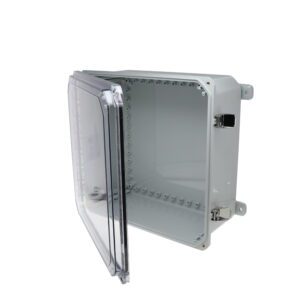
Walk into almost any industrial setting, and you will see cabinets housing centralized automation equipment as well as smaller enclosures for devices on the automation system periphery. These NEMA enclosures for automation systems are a critical yet often overlooked element. They protect and organize the equipment and complex wiring on which automation depends. This blog post covers:
Industrial enclosures house all types of devices, ranging from terminal blocks to motor controls and drives. Invariably, there are cabinets that house programmable logic controllers (PLCs). These are the brains of automation systems that react to inputs and execute commands. Related equipment includes HMI displays (human-machine interfaces), power supplies, relays, and circuit breakers. Other industrial automation equipment may include data communication systems, servers, and controls for lighting, security cameras, and doors.
Selecting an appropriate NEMA or IP rated enclosure ensures that your equipment can withstand the challenges of a factory or hazardous environment. Electronic equipment is sensitive, and industrial facilities may have harsh environments. Exposure to moisture, vibration, chemical spills, excessive heat, and airborne dust can cause equipment failure. Facilities depend on automation for everything from machine operation to HVAC to alarms, so the reliability of industrial automation equipment is essential to productivity and worker safety.
At a minimum, enclosures offer security while limiting access to qualified personnel. Sometimes, the equipment itself may carry high power that should not be exposed to passersby.
What’s more, industrial enclosures offer the opportunity to organize the complexity of wires, making it easier for technicians to troubleshoot issues. Panel builders and engineers can thoughtfully lay out the locations of components inside the enclosure. This simplifies the replacement or addition of components.
The main requirement of NEMA enclosures for automation systems is to provide a safe environment for the equipment it houses. Typically, this means a NEMA-rated cabinet or box that is designed to seal out water and dust. NEMA 12 is a common rating for a controls enclosure. It offers a basic level of protection against dust and dripping water.
In some process plants, equipment is washed down as part of routine cleaning. In such locations, a NEMA 4X enclosure is the most common choice for automation equipment. The rating means the enclosure prevents the ingress of wind-blown dust and hose-directed water. The X signifies the enclosure is corrosion resistant. (Note that NEMA 4 offers higher protection than NEMA 12.)
Some electronics, such as the controls for a security camera, may be located outdoors in wet areas. A NEMA 6 >enclosure may provide the extra waterproof protection that is needed.
There are other useful features available in enclosures. Industrial automation needs electric power. One popular format for providing power to control equipment is a DIN rail. Mounted inside of a NEMA cabinet, a DIN rail allows fast, flexible repositioning of components that snap on to the DIN rail.
Many enclosure suppliers have the ability to print schematics and component labels on the enclosure. This speeds troubleshooting because the technician does not need to look for a manual or diagram.
The size of the NEMA enclosure is simple yet critical. The specifying engineers must calculate the size of the devices to be enclosed and consider the possibility that devices may be added later. To avoid heat buildup and EMI interference, there should be adequate space around components and room to route signal wires away from power cables.
Automation is intersecting with the Industrial Internet of Things (IIoT). As IIIoT adoption grows, the role of enclosures is shifting beyond equipment protection to enabling connectivity. More enclosures are made of plastic so they can send and receive Wi-Fi/Bluetooth signals.
As industrial automation becomes more complex, so does the installation. Cable management accessories are helpful to organize wiring and achieve a clean, understandable layout. Often enclosures for automation systems will be outfitted with temperature sensors, fan controls, and communication for remote monitoring.
Bud Industries offers a broad range of enclosures proven in countless industrial installations. Choose from a number of cabinets, from basic to high-end, or choose from a broad line of full-size cabinet racks.
Inside the automation cabinet, where NEMA protection is not necessary, we offer enclosures with terminal blocks and DIN rail mounts. DIN rails allow for quick repositioning and shifting of components, so engineers or installers can adapt layouts quickly, minimizing.
Some enclosures include windows for infrared communication.
For the edge of the system, we offer small plastic enclosures and junction boxes suitable for wireless devices and outdoor locations. We even offer enclosures for tablet HMIs.
The right Bud NEMA enclosure does more than house components, it ensures reliability and safety in modern industrial automation. By selecting the appropriate enclosure rating and features, manufacturers can protect their investment and support uptime and productivity.
Best of all, we give you industry-leading delivery times, fast modifications, and competitive pricing. Visit our website www.budind.com.