Bud Industries

Published on: December 2, 2025 by Josiah Haas
When electrical enclosures fail due to corrosion, the consequences extend beyond equipment replacement—downtime, safety hazards, and compromised system integrity can multiply costs exponentially. For engineers specifying enclosures for outdoor, marine, or chemically aggressive environments, selecting corrosion-resistant solutions isn’t optional; it is essential. Bud Industries has built its reputation on delivering durable, corrosion-resistant enclosures that meet rigorous NEMA standards, helping engineers protect critical equipment while controlling the total cost of ownership.
Corrosion—the degradation of materials through reaction with their environment—affects both metallic and non-metallic materials. For metals, corrosion typically involves oxidation reactions with moisture, chemicals, salt, and temperature fluctuations. Non-metallic materials such as plastics and fiberglass degrade through various mechanisms including UV exposure, chemical attack, and physical weathering.
For enclosures, understanding these varied corrosion mechanisms underscores why their design matters. Choosing appropriate materials and applying protective surface treatments creates barriers against these environmental threats, significantly extending equipment life and maintaining performance integrity in demanding applications.
Material selection forms the foundation of a corrosion-resistant electrical enclosure:
Aluminum has a natural aluminum oxide layer that protects it from corrosion in wet conditions. While aluminum resists rust, it can corrode in salty or chemical-rich environments.
Plastic enclosures, made from polycarbonate or ABS plastic, are naturally water and salt resistant, and exhibit good resistance to chemicals.
Fiberglass-reinforced polymer provides superior chemical resistance and complete immunity to galvanic corrosion, making it preferred over plastic for enclosures used in highly corrosive chemical processing and marine environments.
Stainless steel delivers exceptional mechanical strength and corrosion resistance, particularly grades 304 and 316, though at a higher material cost than other materials.
Bud Industries maintains extensive product lines across all four material families, enabling engineers to match desired properties for a corrosion-resistant enclosure precisely to environmental conditions. Our engineering team helps customers navigate material selection by evaluating exposure levels, mechanical requirements, thermal management needs, and budget constraints—ensuring the optimal balance between protection and performance for each application.
The answer depends on your specific environment, but NEMA 4X and NEMA 6P ratings specifically address corrosion resistance. NEMA 4X enclosures provide protection against corrosion, windblown dust and rain, splashing water, and hose-directed water, while maintaining functionality when exposed to ice formation. NEMA 6P goes further, offering temporary submersion protection up to specified depths.
The “X” designation specifically denotes additional corrosion resistance beyond standard environmental protection—critical for outdoor installations, coastal facilities, and industrial plants with chemical exposure. These ratings ensure enclosures withstand not just water ingress but also the corrosive effects of salt spray, industrial atmospheres, and chemical washdowns. Bud’s comprehensive line of NEMA/IP-rated enclosures includes numerous 4X-rated solutions engineered and tested to meet these demanding specifications, providing engineers with certified protection they can specify with confidence.
While base material selection provides inherent corrosion resistance, surface treatments and coatings multiply that protection exponentially. These engineered finishes create additional barriers against environmental attack while enhancing appearance and functionality.
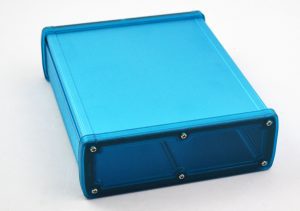
Anodizing transforms aluminum’s natural oxide layer into a thicker, harder protective coating that won’t chip or peel. Bud’s EXN Series of extruded aluminum enclosures feature anodized finishes that enhance corrosion protection while elevating the product’s appearance.
Powder coating applies electrostatically charged polymer particles that cure into tough, uniform finishes. Bud’s in-house powder coating capabilities—including a state-of-the-art coating line—enable rugged, uniform finishes for metal box and rack enclosures. For steel enclosures, powder coating is essential to prevent rust, while for aluminum it provides additional chemical resistance and scratch protection. This process effectively seals metal enclosures against moisture and chemicals while offering color customization for identification or branding. Stainless steel enclosures can be powder coated for extra protection in particularly harsh settings.
Passivation treats stainless steel surfaces with mild oxidants to remove free iron and other contaminants, enhancing the natural chromium oxide layer that gives stainless steel its corrosion resistance. This process is particularly important after machining or welding operations that can compromise surface integrity.
Matching enclosure materials, ratings, and finishes to application environments requires systematic evaluation. For indoor controlled environments, powder-coated aluminum or powder-coated steel enclosures typically provide adequate protection at economical costs. For outdoor general-purpose installations, natural or powder-coated aluminum with NEMA 4X ratings offers reliable weather protection. Marine and coastal applications demand plastic or fiberglass enclosures with NEMA 4X or NEMA 6P ratings to combat salt spray corrosion. Chemical processing and washdown environments benefit from fiberglass NEMA 4X enclosures that resist aggressive chemicals and cleaning agents.
Enclosures rated NEMA 4X or NEMA 6P are specifically designed for these conditions. Bud’s DPH heavy-duty plastic enclosures exemplify this category—offering polycarbonate construction with excellent corrosion resistance and a tightly latching hinged cover.
Bud’s online Product Selector tool guides engineers through the specification process, filtering by NEMA rating, material, size, and mounting options to identify optimal solutions efficiently.
Corrosion resistance in electrical enclosures depends on the synergy between base materials and protective surface treatments. From anodized aluminum to powder-coated steel and fiberglass composites, the right combination delivers decades of reliable protection.
Explore Bud’s corrosion-resistant enclosures and find your match today.
References:
• NACE International (AMPP), “International Measures of Prevention, Application, and Economics of Corrosion Technologies Study”
• NEMA Standards Publication 250, “Enclosures for Electrical Equipment (1000 Volts Maximum)”