Bud Industries

Published on: January 5, 2026 by Josiah Haas
When electronic equipment fails unexpectedly in industrial facilities, the culprit is often invisible: heat. The traditional rule of thumb states that for every 10 degrees Celsius increase in temperature, the life of electrical equipment is cut in half—a sobering reminder that enclosure thermal management directly relates to a company’s survival.
This thermal reality hits hardest in manufacturing facilities, where hundreds of thousands of dollars in high-performance drives and electronics keep production running. Without proper thermal management plans, these critical assets face premature aging and catastrophic failures.
The reason behind failure linked to improper thermal management is that equipment operating outside its temperature range experiences accelerated degradation. Malfunctions can lead to equipment damage and production downtime. That’s why enclosure thermal management shouldn’t be a late-stage consideration, but rather a design requirement that determines reliability and delivers long-term cost savings and proven field performance.
Bud Industries has seen this pattern of improper thermal specifications repeated across thousands of applications from factory automation to edge computing. The common thread is almost always the same: specifiers selected the enclosure before determining the heat load.
Before selecting an enclosure or choosing cooling methods, engineers need a realistic picture of what’s happening inside the box. The process is straightforward:
1. Document heat dissipation for every internal component – Manufacturers typically list power dissipation in watts, BTU/hr, or efficiency percentages.
2. Total all internal heat sources – This defines the total internal thermal load—everything your enclosure must manage.
3. Add external environmental factors – Key considerations include maximum and minimum ambient temperatures, solar loading for outdoor installations, local climate variations, and nearby heat-generating equipment.
4. Determine the cooling requirement – The difference between the maximum allowable internal temperature and the maximum ambient temperature defines how much heat must be removed.
This practical approach helps you avoid the most common issues that we see.
A thermal enclosure is any housing designed to protect electronic components from environmental hazards while maintaining the desired internal temperature. The challenge involves balancing two competing needs: environmental protection requires sealing the enclosure, while thermal management requires heat exchange with the outside environment.
The protection requirements are different for equipment located in an IT room than for equipment located on a factory floor subject to washdown. Rack-mounted equipment is often ventilated. In contrast, factory and outdoor enclosures are typically tightly sealed, which complicates thermal management.
Heat sources within enclosures fall into two categories:
Internal heat generation comes from electronic components, power supplies, variable frequency drives, processors, transformers, and control systems.
External heat sources include solar radiation on outdoor installations and high ambient temperatures in industrial settings. Nearby processes such as welding, furnaces, or paint ovens also emit radiant heat.
Material choice significantly impacts thermal performance. Metal enclosures manufactured from aluminum and steel, for example, excel at heat dissipation through conduction and radiation. Aluminum offers superior thermal conductivity, while stainless steel (like Bud’s SNB Series) adds durability.
Plastic enclosures (polycarbonate, ABS) offer environmental protection and electrical insulation but conduct heat poorly. Material selection should balance operating environment, heat load, and protection requirements.
When designing effective enclosure thermal management systems, engineers must choose between two fundamental approaches—or strategically combine both.
Passive cooling uses zero electricity during operation and is entirely silent as it has no moving parts, making it ideal for remote installations, noise-sensitive environments, and applications where power availability is limited.
Passive methods rely on natural heat transfer through conduction, convection, and radiation. Conduction uses the material of the enclosure (metal) to absorb heat and then radiate the heat outside of the enclosure. Natural convection ventilation uses strategically placed vents or louvers that allow heated air to escape through top openings while cooler air enters through bottom vents. The “chimney effect” keeps the air moving.
Consider heat sinks and thermal mass to facilitate enclosure heat dissipation. For example, design elements such as finned aluminum panels increase surface area for enhanced radiation and convection.
Passive systems require no power and are maintenance-free, offering long-term reliability with minimal ongoing costs. However, ambient conditions limit cooling capacity, leaving them insufficient for high-density equipment or extreme environments.
Active thermal management also protects against device failure, using tools such as air conditioners to help control temperature and moisture.
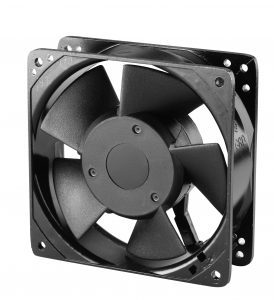
Active cooling employs powered devices to enhance heat removal. Cooling fans create forced convection, dramatically increasing air movement across components and heat sinks. Thermostatically controlled fans activate only when needed, balancing performance with energy efficiency.
Air conditioning units provide precise temperature control for high-heat applications, maintaining closed-loop circulation that prevents contamination while removing significant thermal loads. Heat exchangers transfer heat from enclosure air to external air without mixing the two environments, protecting sensitive electronics from contaminants while achieving effective cooling.
Active systems deliver superior cooling capacity and precise temperature control but require power, periodic maintenance, and generate noise and vibration. HVAC equipment consumes significant space and has high operating costs, making cost-benefit analysis essential.
Effective enclosure thermal management begins at the design stage, long before equipment installation. Several fundamental strategies optimize heat dissipation:
Component placement and spacing. Position heat-generating equipment away from temperature-sensitive devices, with adequate airflow clearances. Mount high-heat components toward the top of enclosures where natural convection assists cooling, as heated air is less dense and will rise to the top of the enclosure.
Airflow optimization requires analyzing internal pathways to prevent dead zones and ensure continuous circulation. Baffles and ducting can direct cooling air across critical components while preventing short-circuiting of ventilation paths. To increase airflow, Bud offers a wide variety of vents that can be added to an enclosure. We even offer vents that allow airflow while blocking moisture, enabling your enclosure to maintain its IP65 or IP67 protection rating.
External surface treatment influences thermal performance through color and finish selection. Light-colored exteriors reflect solar radiation on outdoor enclosures, reducing absorbed heat. Dark finishes enhance thermal radiation for indoor applications where solar load isn’t a concern.
Thermal enclosure sizing takes into consideration equipment dimensions and thermal requirements. Oversized enclosures provide more internal air volume to buffer temperature swings and reduce heat density.
Successful enclosure thermal management requires understanding how design choices impact heat dissipation. The investment in proper thermal design—whether through passive cooling optimization, active thermal management systems, or strategic combinations of both—pays continuous dividends through extended equipment life, reduced maintenance requirements, and the elimination of costly thermal failures.
Engineers choose Bud for thermal-sensitive designs because: