Bud Industries

Published on: January 29, 2026 by Josiah Haas
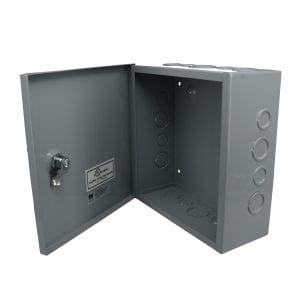
Let’s say customers are complaining that your design is experiencing a high failure rate. One possible root cause could be an enclosure that is not providing sufficient protection for the internal electronic and electrical components. The engineers responsible for enclosure selection may not have been aware of or did not consider all the potential hazards where the equipment would reside. As a result, they did not specify an enclosure that shielded the electronics from all potential threats. Hazards impinging on the enclosure include moisture, dust, corrosive chemicals, driving rain, ice and mechanical impacts.
Understanding the NEMA enclosure standards and having a comprehensive checklist will enable the selection of an enclosure appropriate for the environment where it will operate. The following paragraphs will provide an overview of the NEMA enclosure standard, a resource for explaining the NEMA enclosure definitions, and a checklist to permit the specification of a proper enclosure for your application. Using these tools will result in choosing an enclosure that is neither inadequate for the enclosure environment, leading to poor product reliability, nor overspecified, resulting in a high cost.
The National Electrical Manufacturers Association (NEMA) created performance-based ratings that define how enclosures protect equipment against environmental hazards. These ratings provide engineers with a universal language to specify protection levels without being overwhelmed by technical specifications.
NEMA ratings establish clear benchmarks for protection against moisture, dust, corrosion, ice formation, and accidental contact with hazardous parts. The system ranges from basic indoor protection (NEMA 1) to heavy-duty outdoor applications (NEMA 4X). A NEMA 4X rating instantly communicates protection against corrosion, windblown dust, rain, sleet and hose-directed water–critical information in a single designation. For more complete details on the NEMA ratings, see the NEMA Rating Guide for Electronic Enclosures.
Step 1: Identify All Environmental Threats
Document every threat equipment will encounter:
Step 2: Determine Indoor or Outdoor Placement
Location dramatically narrows viable options. Indoor environments typically present fewer threats, but outdoor installations demand higher protection levels.
Step 3: Choose the Appropriate NEMA Rating
Match documented conditions to the appropriate NEMA rating. Below we provide a listing of ratings most often used by designers:
NEMA 1: Clean, indoor environments with minimal hazards. Protects against accidental contact and falling dirt. Suitable for climate-controlled spaces.
NEMA 3R: Outdoor protection against rain, sleet, snow and falling dirt. Common for outdoor electrical panels and utility installations.
NEMA 4: Indoor or outdoor use when equipment faces windblown dust, rain, splashing water and hose-directed water. Essential for washdown procedures.
NEMA 4X: Everything NEMA 4 offers plus corrosion resistance. Critical for coastal environments and chemical plants.
NEMA 12: Indoor dust-tight and drip-tight protection. Blocks dust, lint, fibers and light liquid seepage. Ideal for manufacturing facilities and automation equipment.
Select the lowest NEMA rating that meets all identified needs. Over-specification increases costs without adding value.
Step 4: Select Enclosure Material
Material selection balances environmental protection, mechanical strength and budget:
Plastic (Polycarbonate, ABS): Lower cost with excellent electrical insulation. Resists corrosion naturally and provides good thermal insulation.
Steel: Superior mechanical strength for heavy-duty use. Requires coating for corrosion resistance. Excellent EMI shielding.
Stainless Steel: Outstanding corrosion resistance without coatings. Essential for chemical processing and food production. Can be costly.
Aluminum: Lighter than steel with natural corrosion resistance. Popular for portable equipment.
Fiberglass: Exceptional strength-to-weight ratio. Non-conductive and highly corrosion-resistant for environments with chemical exposure.
Step 5: Specify Required Features
Address specific needs. Does the enclosure require any of the following features?
Each feature can impact protective integrity. Choose these features, understanding that every penetration potentially compromises environmental sealing.
The choice between NEMA 1 and NEMA 12 illustrates how environmental assessment drives selection. Consider a control panel in a climate-controlled server room versus one in an automotive manufacturing facility. The server room features filtered air — a textbook NEMA 1 application providing basic protection against accidental contact and falling particulates. NEMA 1 has no gaskets or other seam protection.
Bud has a complete line of NEMA 1 enclosures, including our JB Series Steel Junction Boxes and our JBH Series Hinged Cover Steel Junction Boxes. These enclosures range in size from 4.00” x 4.00” x 3.00” to 10.00” x 8.00” x 6.00”.
In contrast, a manufacturing environment may be dusty or have airborne metal shavings. A NEMA 1 enclosure allows dust infiltration through panel seams, potentially causing shorts and component degradation.
A NEMA 12 enclosure is a better choice for a factory floor where the environment may be dirty. NEMA 12 enclosures feature gasketed doors, sealed knockouts, and tight construction that block airborne dust, lint, fibers, and dripping liquids. NEMA 12 protects against dripping fluids as well as seeping oil and coolant that could drip down the sides of the enclosure.
Our SN Series Steel Electronics Enclosures are a popular choice for NEMA 12 enclosures. SN models range in size from 6.00” x 4.00” x 3.00” to 16.00” x 14” x 6.00”.
Keep in mind that NEMA 12 does not guarantee that the cabinet provides waterproof protection. If that is what you need, a NEMA 4 or 4X enclosure is a better choice. Despite the large number, NEMA 12 provides only a basic level of protection. It may be helpful to think of it as NEMA 1.2 rather than NEMA 12.
The cost differences between NEMA 1 and NEMA 12 appear minimal against equipment replacement costs and production downtime. Engineers who choose NEMA 12 for dusty environments invest once rather than repeatedly addressing failures.
NEMA standards carry no legal authority. However, practical reality creates de facto requirements.
The National Electrical Code and local electrical codes frequently refer to NEMA ratings for required protection levels. Insurance companies increasingly mandate specific ratings for coverage. Engineers bear professional responsibility for specifying appropriate protection. Installing inadequate enclosures creates liability exposure.
Customer specifications commonly require NEMA ratings as baseline qualifications. Industry certifications evaluate products using NEMA standards as benchmarks. The practical effect transforms voluntary standards into necessary specifications, providing universally recognized shorthand that satisfies stakeholders and streamlines approvals.
Successful NEMA enclosure selection follows clear steps: documenting threats systematically, determining indoor versus outdoor placement, matching conditions to appropriate NEMA ratings, choosing materials balancing protection with budget and specifying features supporting operations without compromising integrity.
This systematic approach ensures equipment protection while efficiently meeting project requirements. Invest time in an accurate assessment, and your systems will deliver reliable performance.
When you need either standard or custom NEMA enclosures, Bud Industries specializes in meeting your needs with precision manufacturing and full regulatory compliance. Visit budind.com to explore enclosure solutions for all your challenging applications.