Bud Industries

Published on: June 4, 2026 by Josiah Haas
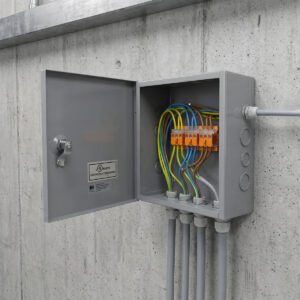
Like a deadbolt on your front door, a NEMA 1 enclosure isn’t designed to stop every threat imaginable, but it’s the fundamental layer of security you’d never leave out. For engineers specifying indoor enclosures, NEMA 1 is the baseline rating that keeps people safe from live components and keeps falling debris away from sensitive electronics. Here’s what you need to know to specify it with confidence.
The National Electrical Manufacturers Association (NEMA) created a rating system that defines how well an enclosure protects the equipment inside from environmental hazards. The standards were first defined in the 1930s and expanded and revised through the 1950s. NEMA 1 is the entry-level rating in that system, designed exclusively for indoor use.
A NEMA 1 enclosure provides protection against two specific threats: accidental contact with hazardous internal parts, and ingress of solid foreign objects like falling dirt. That’s it. No water resistance, no dust-tight seal, no corrosion protection. NEMA 1 assumes a controlled indoor environment where rain, humidity, and airborne particulates aren’t factors.
The construction reflects this focused purpose. NEMA 1 enclosures typically lack gaskets or sealed seams because they don’t need them. This keeps the cost down and the design straightforward, which is exactly the point for applications where heavier protection would be overkill.
A good example of a NEMA 1 application is a homeowner in Ohio who built a photovoltaic water-heating controller. He used a Bud Industries JBH‑4960‑KO, a 10″ × 10″ × 4″ steel NEMA 1 hinged box, to house the controller, contacts, and wiring. He mounted the enclosure inside his utility room next to the water heater. He chose the enclosure because NEMA 1 was sufficient for the utility room location, because the box had knockouts for routing his DC and 240 V AC lines in and out, and because the hinged cover lets him open the box for service without unscrewing the cover.
No, and this is a common misconception worth clearing up. NEMA 1 enclosures protect against falling dirt, meaning debris that drops onto the enclosure from above. They do not protect against circulating dust, airborne fibers, lint, or fine particulates that can drift in through panel seams and unsealed openings.
If your application involves a dusty environment, such as a manufacturing floor with metal shavings, a woodworking shop, or any space where airborne particles are a concern, NEMA 1 will not keep that contamination out. Dust infiltration can cause shorts, accelerate corrosion on circuit boards, and degrade components over time.
For dusty indoor environments, a NEMA 12 enclosure is the better choice. NEMA 12 adds gasketed doors and sealed construction that block circulating dust, lint, fibers, and dripping liquids. It may be helpful to think of NEMA 12 as “NEMA 1.2” rather than a dramatically higher tier, because despite the larger number, NEMA 12 provides a relatively modest step up in protection. But for keeping dust out, that step makes all the difference.
NEMA 1 is the right call when you need basic indoor protection and nothing more. Choosing it wisely saves money without sacrificing reliability. They are commonly used in factory automation, security, and industrial electrical applications. Here are the applications where NEMA 1 earns its place:
Climate-controlled offices and server rooms. Where the air is filtered and temperature is regulated, a NEMA 1 enclosure provides all the protection your lighting controls, A/V equipment, or security panels need. There’s no environmental stress to defend against beyond accidental contact and the occasional falling particle.
A common application of a NEMA 1 enclosure is as an electrical pull box. When I walk through commercial buildings, I see our boxes installed on ceilings and walls to splice branch circuits and extend conduit runs. Our JB series box is electrical code-compliant, has provisions for grounding, and is economical compared to sealed enclosures.
Indoor electrical junction boxes. In clean commercial and residential settings, NEMA 1 junction boxes house wiring connections safely and meet code requirements without adding unnecessary cost.
I remember an application where a man mounted a Bud JBH‑4961‑KO junction box next to his furnace to consolidate the transformer, fuses, and wire splices that his internet-enabled thermostat needed. He wanted an enclosed metal box for “fire safety” per local code.
Another man selected a similar NEMA 1 enclosure to house power distribution for an observatory. He selected the Bud junction box because its steel construction enabled a clean ground.
Control panels in industrial facilities. If the indoor environment stays dry and relatively free of airborne contaminants, NEMA 1 gives you a cost-effective housing for industrial controls.
Most of the NEMA 1 applications that we see are similar to this story. A small manufacturer installed a wall-mounted steel junction box near a conveyor line to terminate sensors into terminal blocks and route wiring back to a PLC panel. The engineer used the box’s knockouts to attach conduit. In the clean indoor environment, the enclosure’s main job is to keep the connections secure.
OEMs also use our NEMA 1 enclosures mounted directly on a machine frame. I remember one application that housed a control board, relays, power distribution block, fuses, and a small 24V power supply. Lots of machines need sub-panels that interface with the equipment, and a NEMA 1 box provides that platform cost effectively.
The key question to ask: will this enclosure encounter moisture, dust, chemicals, or outdoor conditions at any point during its service life? If the answer is yes to any of those, step up to a higher rating. NEMA 1 enclosures are not rated for outdoor use, and installing one outside is an invitation for early equipment failure.
Understanding where NEMA 1 sits relative to other common ratings helps you make faster, more accurate specifications. A NEMA 3R enclosure adds rain, sleet, and ice protection for outdoor use. NEMA 4 handles hose-directed water and windblown dust. NEMA 4X adds corrosion resistance on top of NEMA 4’s capabilities. Each step up addresses specific threats that NEMA 1 was never designed to handle.
For a deeper dive into these ratings, see the NEMA Rating Guide for Electronic Enclosures on the Bud Industries website.’
When selecting a NEMA 1 box, look for practical features that speed installation and real wiring jobs. A good example of a NEMA 1 steel enclosure is Bud Industries’ JB Series NEMA 1 junction box. It was designed for industrial and commercial electrical wiring, including junction and pull-boxes. The JB Series has removable knockouts on all four sides, wall-mount holes, and an embossed grounding hole for flush wall mounting. A version with a hinged cover, the JBH Series Hinged Cover Steel Junction Box, makes it easy to work inside the box.
These boxes range in size from 4.00″ x 4.00″ x 3.00″ to 10.00″ x 8.00″ x 6.00″ and ship quickly from stock.
If the box is part of an OEM product, Bud offers custom colors and labeling. Of course, Bud provides certifications for industries requiring proof of NEMA 1 compliance.
And when your project calls for cutouts or other modifications, only Bud delivers them in as few as five days on most in-stock enclosures. Browse the full lineup at budind.com.